
What Is the Best Type of Agaricus Blazei Extract in 2026?
Choosing the best Agaricus Blazei Extract in 2026 requires more than comparing bright labels and impressive mushroom percentages. The strongest option depends on extraction method, measurable compounds, cultivation standards, and independent testing. A powder may suit someone seeking flexibility, while a standardized capsule offers easier daily consistency. Neither format is automatically superior. The details matter.
This guide examines fruiting-body and mycelial products, hot-water and dual-extraction processes, and the evidence behind their stated beta-glucan content. It also considers whether labels clearly separate beta-glucans from starch, identify the species, and disclose the extraction ratio. A careful buyer should look for certificates of analysis, contaminant screening, and traceable manufacturing. These checks cannot prove every benefit. They can reduce avoidable uncertainty.
Experience with functional mushroom products also teaches caution. Texture, aroma, and batch consistency can reveal quality concerns, but they are not laboratory proof. Some marketing claims sound confident without strong human research. That is where this comparison stays deliberately critical. We will weigh credible studies, transparent sourcing, and practical usability rather than promising dramatic results. Readers should consider personal health conditions and discuss supplementation with a qualified professional. The “best” extract may be the one with honest documentation, realistic expectations, and dependable quality—not the loudest claim.
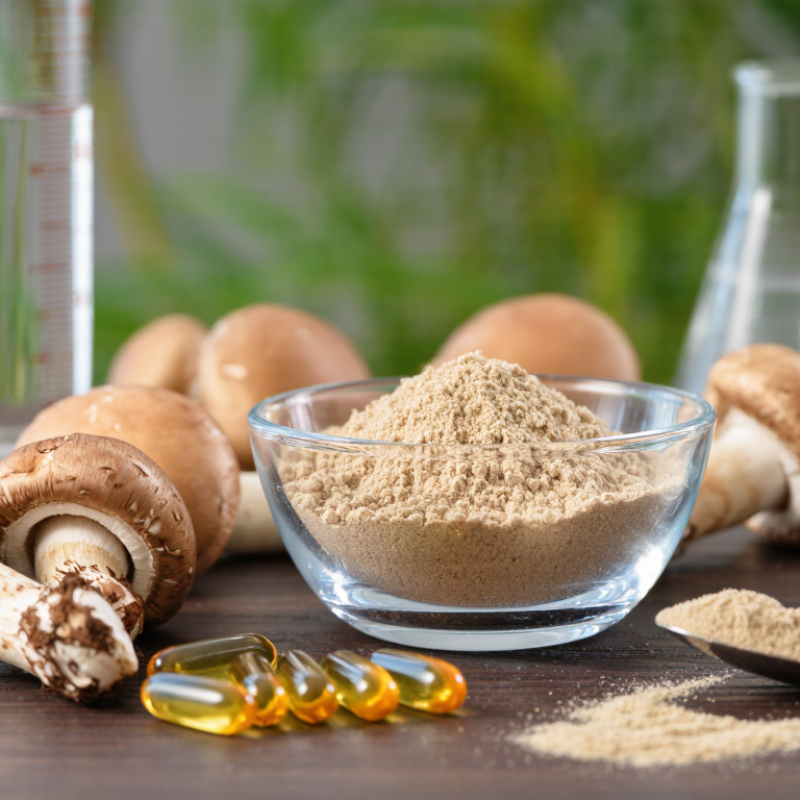
What Agaricus Blazei Extract Is and Why Its Form Matters
What Is the Best Type of Agaricus Blazei Extract in 2026?
Agaricus blazei extract comes from a medicinal mushroom often studied for its beta-glucans and other polysaccharides. The word extract does not describe one identical product. Its form depends on the mushroom material, extraction method, concentration, and testing standards.
Hot-water extraction is common because it helps release many water-soluble polysaccharides. Some products also use alcohol extraction for compounds that water may not extract well. A dual extract can therefore offer broader chemical coverage, but “more” does not automatically mean “better.”
I once assumed a higher percentage guaranteed better quality. That assumption needs checking.
Form matters in practical use. A powder may mix easily into warm water, while capsules offer more consistent serving sizes. Standardized extracts can make comparisons easier, especially when the label identifies beta-glucan content. However, a declared polysaccharide percentage may include compounds with different properties. Clear testing is essential.
Look for the scientific name, used mushroom part, extraction method, and serving amount. Independent testing should check identity, heavy metals, microbes, and unwanted contaminants. Clinical evidence for Agaricus blazei remains limited, so responsible descriptions should avoid promising disease prevention or treatment. People with medical conditions or regular medicines should consult a qualified healthcare professional before use. Freshness also matters; a poorly stored powder may lose quality before the label’s promise is tested.
How Cultivation, Source, and Processing Affect Extract Quality
What Is the Best Type of Agaricus Blazei Extract in 2026?
How Cultivation, Source, and Processing Affect Extract Quality
The best Agaricus blazei extract starts with verified raw material, not attractive packaging. Fruiting bodies and mycelium can differ in beta-glucan profiles. Substrate also matters, especially when agricultural residues are used. FAOSTAT recorded more than 12 million tonnes of global mushroom-and-truffle production in 2022. However, the dataset does not separate A. blazei extracts. USDA’s 2023–2024 Mushrooms report recorded about 788 million pounds of U.S. mushroom sales. It also does not prove species identity or extract potency. Scale is not quality.
Look for controlled cultivation records, full Latin naming, and batch-level testing. DNA barcoding can support species authentication. Microscopy adds useful, practical confirmation. A strong certificate of analysis should show beta-glucans, moisture, microbes, pesticides, and heavy metals. The testing method matters. Some “polysaccharide” results may include starch or other alpha-glucans. That can make a label look stronger than it is.
Processing changes the final profile. Hot-water extraction suits many water-soluble compounds. Ethanol or dual extraction may capture different fractions. Excessive heat can damage sensitive constituents, while poor drying can encourage moisture-related spoilage. I would prefer a documented extraction ratio over a dramatic potency claim. More concentrated is not automatically better. One uncomfortable limitation remains: published A. blazei studies often use different assays and cultivation conditions. Comparisons are therefore imperfect. Buyers should judge consistency across batches, not one impressive laboratory number.
Which Active Compounds and Standards Define a Quality Extract
What Is the Best Type of Agaricus Blazei Extract in 2026?
A quality Agaricus blazei extract begins with verified identity, not attractive packaging. Suppliers should document species authentication through microscopy, DNA testing, or both. This matters because mushroom powders can contain mixed species. The active profile also needs attention. Beta-glucans are usually the main quality marker, while proteoglycans, ergosterol, and phenolic compounds add useful context. “Polysaccharides” alone is too vague.
Testing should distinguish beta-glucans from alpha-glucans, such as starch. Enzymatic beta-glucan assays are more informative than a broad polysaccharide number. A 2023 review in Foods noted that cultivation conditions, extraction solvents, and reporting methods can substantially change measured mushroom compounds. That makes direct comparisons imperfect. Still, the weakness is often overlooked.
Reliable documentation should include batch-specific results. Look for beta-glucan percentage, moisture, microbial counts, heavy metals, pesticide screening, and residual solvents. USP <2021> provides microbial testing guidance for dietary supplements, while USP <2232> addresses elemental contaminants. Testing from an ISO/IEC 17025-accredited laboratory adds credibility. It is not absolute proof. Extraction can also damage heat-sensitive compounds or leave valuable material behind. I would question any report offering one impressive number without its test method, raw material details, and acceptance limits.
What Is the Best Type of Agaricus Blazei Extract in 2026? — Which Active Compounds and Standards Define a Quality Extract
| Evaluation Dimension | Extract Type or Quality Feature | Relevant Active Compounds or Markers | What a Quality Specification Should Show | Why It Matters | Recommended Verification |
|---|---|---|---|---|---|
| Overall extract choice | Standardized hot-water extract, or a hot-water-dominant extract with a clearly declared secondary alcohol fraction | β-D-glucans Protein-bound polysaccharides Ergosterol Phenolic compounds | Declared extraction solvent, mushroom part, extraction ratio, and a batch-specific assay for β-glucans rather than an unspecified “polysaccharide” percentage. | Hot water is suitable for extracting many water-soluble mushroom polysaccharides. A mixed-solvent process may broaden the chemical profile, but it should not replace transparent labeling and testing. | Review the certificate of analysis, analytical method, and the relationship between raw-material weight and finished-extract weight. |
| Species identity | Authenticated Agaricus blazei, with nomenclature clarified | Agaricus blazei Murrill Agaricus subrufescens DNA identity | The label should identify the scientific name used by the supplier and the material should be traceable to authenticated fruiting bodies or mycelium. | Agaricus blazei is also commonly discussed under the name Agaricus subrufescens. Correct identity reduces the risk of substitution with another mushroom species. | Use macroscopic or microscopic identification together with DNA-based authentication when appropriate; DNA testing alone may not describe extract composition. |
| Primary active compound | β-D-glucan-standardized extract | β-(1→3)-glucans β-(1→6)-glucans | β-glucan content is reported separately from total polysaccharides, with the test method, units, and batch result stated. | β-glucans are important structural polysaccharides in mushrooms. “Total polysaccharides” can also include starch, dextrins, or other non-β-glucan carbohydrates. | Prefer a validated enzymatic β-glucan method or another recognized method that distinguishes β-glucans from α-glucans and explains its reporting basis. |
| Polysaccharide integrity | Low-starch, non-adulterated extract | β-glucan α-glucan Total carbohydrate | α-glucan or starch-related carbohydrate is disclosed where relevant, and the reported β-glucan value is not presented as total carbohydrate. | High total-polysaccharide numbers can be misleading when starch or carrier carbohydrates contribute substantially to the result. | Compare β-glucan, α-glucan, total carbohydrate, and excipient results on the same certificate of analysis. |
| Secondary chemical markers | Chemically characterized extract | Ergosterol Phenolic compounds Agaritine Nucleosides | At least one orthogonal marker, such as ergosterol or a validated chromatographic profile, is reported when the extract is promoted as chemically standardized. | These compounds can help characterize the raw material and extraction profile, but they should not be treated as interchangeable with β-glucan content. | Use HPLC, LC-MS, or another fit-for-purpose chromatographic method with reference standards and documented sample preparation. |
| Fruiting body versus mycelium | Clearly declared biological material | Fruiting-body constituents Mycelial biomass Cultivation substrate | The label states whether the extract is made from fruiting bodies, mycelium, or a combination, and identifies any growth substrate or carrier. | Biological material and cultivation substrate can affect the chemical profile, ash content, carbohydrate profile, and contaminant risk. | Check raw-material specifications, microscopy or DNA documentation, substrate information, and the finished-product certificate. |
| Extraction process | Documented hot-water or hydroethanolic process | Water-soluble polysaccharides Sterols Phenolics | Temperature range, solvent composition, number of extraction cycles, concentration step, drying process, and carrier materials are documented. | Extraction conditions influence which compounds are recovered and can affect degradation, residual solvent levels, and batch-to-batch consistency. | Request a process specification or quality dossier rather than relying only on the phrase “high potency.” |
| Contaminant control | Tested and released under written limits | Heavy metals Pesticide residues Microbial count Mycotoxins Residual solvents | Every batch or defined testing interval has results for contaminants relevant to the cultivation and extraction process, with limits tied to the intended market. | Mushrooms can accumulate environmental contaminants, while water-based and solvent-based processes create different microbiological and residual-solvent considerations. | Use qualified third-party laboratories where possible and verify the test date, lot number, method, units, and acceptance limits. |
| Physical and stability quality | Stable, reproducible powder or liquid extract | Moisture Water activity Particle size Shelf life | Moisture or water activity, packaging conditions, storage temperature, lot number, and expiry or retest date are specified. | Moisture and storage conditions affect caking, microbial stability, oxidation, and the reproducibility of the delivered dose. | Review stability data and confirm that the certificate of analysis corresponds to the actual lot supplied. |
| Best practical standard | Multi-parameter standardization | Identity β-glucan α-glucan Ergosterol or profile marker Contaminants | A strong specification combines authenticated species identity, declared biological material, quantified β-glucans, transparent carbohydrate testing, chemical profiling, and contaminant limits. | No single compound defines every aspect of Agaricus blazei extract quality. A multi-parameter approach is more informative than a high percentage of unspecified polysaccharides. | Assess the complete technical dossier and certificate of analysis, not only the marketing percentage or extraction ratio. |
How Powders, Capsules, and Liquid Extracts Compare
What Is the Best Type of Agaricus Blazei Extract in 2026?
How Powders, Capsules, and Liquid Extracts Compare
Agaricus blazei powders offer flexibility. You can mix them into oatmeal, soup, or a morning drink. They often cost less per serving, but measuring them can become inconsistent. Taste matters too. A bitter, earthy spoonful may discourage regular use. Check the label for the mushroom’s scientific name, extraction method, and beta-glucan content. “Mushroom powder” alone may describe ground material rather than a concentrated extract.
Capsules provide cleaner dosing and easier travel. They also hide the strong flavor. However, capsule weight does not reveal extract strength. Two products may contain identical-looking capsules but very different beta-glucan levels. Reliable manufacturers should provide batch testing, contaminant screening, and clear ingredient amounts. I would be cautious when a label lists only a proprietary blend. It saves space, but removes useful detail.
Liquid extracts can work well for people who dislike swallowing capsules. Their flexible serving size is convenient, especially when adding drops to water. Yet liquids may need refrigeration after opening, and flavor can remain noticeable. Alcohol-free versions may suit some preferences, but extraction chemistry still deserves attention. In practical comparisons, the best choice depends on testing, transparency, and consistency rather than format alone. No form wins every time. Evidence for specific health benefits remains limited, so avoid treating any extract as a replacement for medical care. A smaller, clearly tested product may be wiser than a large, impressive-looking container.
How to Choose the Best Agaricus Blazei Extract in 2026
Choosing the best Agaricus blazei extract in 2026 requires more than reading a high-strength label. Check the mushroom source, extraction method, and tested compounds. Fruiting-body extracts may offer clearer ingredient information than vague “mushroom complex” powders. Look for measured beta-glucan content, not only total polysaccharides. These terms are not interchangeable. A hot-water extract suits many traditional formulations, while dual extraction may capture additional compounds. Evidence remains developing, so avoid products promising disease treatment or dramatic immune effects.
Tips: Choose transparent labels, recent independent testing, and clear serving sizes. Check for heavy metals, microbes, pesticides, and undeclared fillers. A batch number and certificate of analysis improve trust. I would also compare the actual beta-glucan amount per serving, because a large capsule count can hide a weak formula. Taste matters too; a clean, earthy smell is more reassuring than strong perfume-like flavor, though sensory checks cannot prove safety.
Your health history should guide the final choice. Speak with a qualified healthcare professional if you take immune-modulating medicines, blood thinners, or medicines for diabetes. Stop use if unusual digestive symptoms or allergic reactions appear. I once assumed a higher extract ratio meant better value, but that shortcut was incomplete. Extraction ratios can describe starting material, not final active content. Choose products with traceable manufacturing, realistic claims, and testing that matches the label. A cautious decision is usually the more professional one.


