


Top Solid 27mm 3 Layer Yellow Formwork Panel Supplier?
Choosing the Top Solid 27mm 3 Layer Yellow Formwork panel Supplier requires more than comparing prices or surface color. Construction teams need stable panels, dependable delivery, and evidence of consistent manufacturing. The Global Formwork Market report by Grand View Research highlights rising demand for efficient, reusable formwork systems, especially where projects face tighter schedules and higher labor costs. This trend makes supplier verification increasingly important.
A reliable supplier should provide clear technical data for thickness, core structure, bonding quality, moisture resistance, and allowable reuse cycles. The panel should remain reasonably flat after repeated concrete contact. Its yellow film should resist peeling around cut edges and bolt holes. Small details matter. Ask for batch inspection records, production photographs, and independent test results. Standards such as EN 13986 and relevant plywood testing procedures can support this evaluation, although local project specifications must remain decisive.
The Solid 27mm 3 Layer Yellow Formwork panel may suit walls, slabs, and other concrete applications when its design matches the site conditions. However, no panel performs perfectly under poor storage, excessive vibration, or uncontrolled moisture. That point is easy to overlook. The 2024 Timber Construction and Engineered Wood Products analyses from organizations such as FAO and industry research publishers also reinforce the importance of responsible sourcing, documented quality, and material consistency. Supplier experience should be measured through completed projects, not impressive promises. A practical review should examine sample panels, edge sealing, delivery packaging, and technical support before signing a purchase contract. Cost matters, but replacement rates matter more. Sometimes, the cheapest quotation is not the economical choice.
What Is a Solid 27mm Three-Layer Yellow Formwork Panel?
Top Solid 27mm 3 Layer Yellow Formwork Panel Supplier?
What Is a Solid 27mm Three-Layer Yellow Formwork Panel?
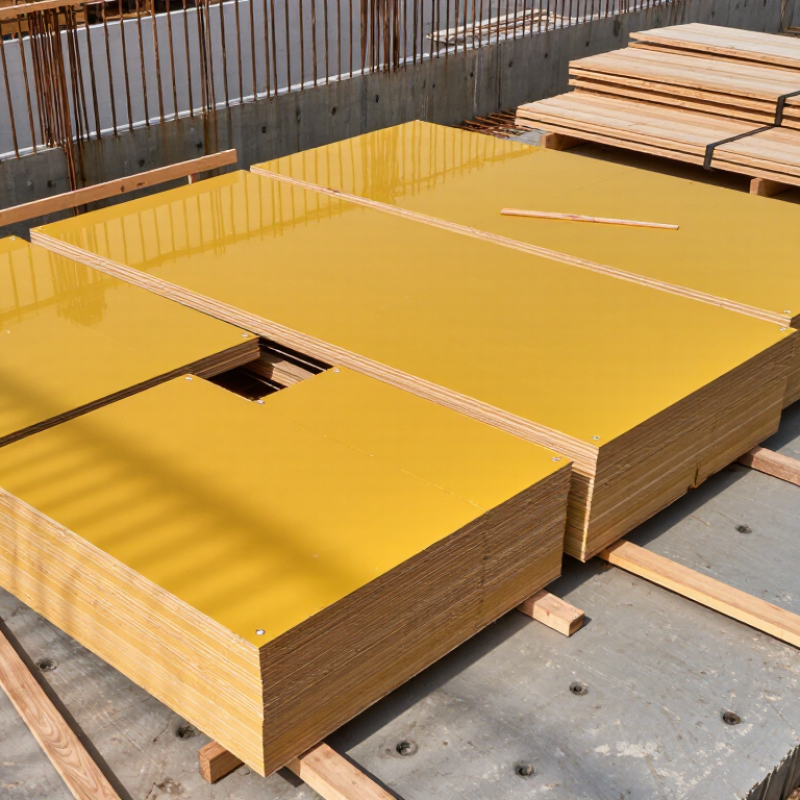
A solid 27mm three-layer yellow formwork panel is an engineered plywood sheet for repeated concrete casting. It usually contains a thick central core and two balanced outer layers. A yellow phenolic film covers both faces, creating a smoother release surface. The 27mm thickness improves stiffness under fresh concrete pressure, while the three-layer structure helps reduce warping.
The word “solid” needs careful checking. It should describe a dense, continuous panel core, not solid timber. Buyers should verify veneer thickness, core gaps, bonding quality, film weight, and edge sealing. EN 636 addresses plywood performance conditions, while EN 314-2 classifies bonding durability. These standards support technical evaluation, but they do not guarantee every panel’s jobsite life.
FAO’s FAOSTAT forestry data reports global plywood production above 160 million cubic metres in recent years, showing the scale of this material sector. The UNECE/FAO Forest Products Annual Market Review also links panel demand with construction activity and renovation. Field experience still matters more than a catalogue claim. A dry, flat panel may survive many pours, but rough stripping, standing water, or unsealed edges can shorten its service life. That detail is often underestimated.
The yellow surface is practical.
Inspect the panel before installation.
| Data Dimension | Typical Specification | Practical Description and Verification Point |
|---|---|---|
| Product Type | Three-layer yellow formwork panel | A structural wood-based panel made from three bonded veneer layers and finished with a yellow surface film or coating for concrete-forming applications. |
| Nominal Thickness | 27 mm | The nominal thickness is 27 mm. Actual thickness should be checked with a calibrated micrometer because manufacturing tolerances may apply. |
| Layer Structure | 3 veneer layers | The face, core, and back veneers are generally cross-oriented to improve dimensional stability and load distribution compared with a single solid wood board. |
| Panel Dimensions | Common formats include 1,220 × 2,440 mm and 1,250 × 2,500 mm | Other sizes may be available. Confirm the usable dimensions, squareness, thickness tolerance, and edge straightness before ordering. |
| Yellow Surface | Phenolic film or protective coating | The yellow surface is normally intended to reduce moisture penetration, improve release from concrete, and protect the panel during handling. Film weight and surface finish should be specified separately. |
| Core Material | Hardwood or other structural veneer | The wood species and veneer grade affect stiffness, screw-holding capacity, surface quality, and service life. Request the species or grade in the technical datasheet. |
| Adhesive Performance | Exterior or weather-resistant bonding required | For repeated concrete use, ask for evidence of water-resistant bonding, such as boiling-water resistance or an equivalent applicable plywood test result. |
| Typical Density | Approximately 500–700 kg/m³ | Density varies with wood species, veneer moisture, and manufacturing process. Use the declared density for weight calculations rather than relying only on a typical range. |
| Approximate Panel Weight | About 36–52 kg for a 1,220 × 2,440 × 27 mm panel | This estimate is calculated from panel volume and the typical density range. Actual weight changes with panel dimensions, moisture content, and wood species. |
| Concrete-Facing Quality | Smooth, low-defect face preferred | Check for open joints, core gaps, blisters, wrinkles, sanding marks, repaired areas, and uneven coating because these may transfer to the concrete surface. |
| Edge Treatment | Sealed or edge-protected | Painted or sealed edges help limit water absorption and delamination during use. Inspect cut edges and confirm whether factory edge sealing is included. |
| Expected Reuse | Project-dependent; commonly several uses | Reuse depends on concrete pressure, panel quality, release agent, storage, cleaning, fastener placement, and whether edges are damaged. A fixed reuse count should not be accepted without project evidence. |
| Moisture Handling | Suitable for temporary wet-site exposure when properly protected | Store panels flat, raised above the ground, and covered with ventilation. Do not leave the edges or panel stacks exposed to standing water. |
| Machining and Fastening | Can be cut, drilled, and screwed with standard woodworking tools | Seal all newly cut edges and pre-drill near edges where necessary to reduce splitting. Avoid excessive nail or screw spacing that can damage the veneers. |
| Quality Documents | Required before bulk purchase | Request a technical datasheet, dimensional tolerance report, adhesive classification, surface-film information, packing specification, and batch inspection records. |
| Supplier Evaluation | Verify before ordering | Compare samples, test reports, production capacity, lead time, packaging, loading method, warranty terms, and the supplier’s ability to maintain consistent thickness and layer construction. |
| Best-Fit Applications | Walls, columns, slabs, beams, and general concrete formwork | Use the panel only after confirming its structural capacity, support spacing, and allowable deflection for the specific formwork design and concrete placement method. |
Note: The specifications marked as typical are industry-oriented reference values. Final purchasing requirements should be based on the supplier’s current technical datasheet, approved sample, inspection results, and the structural design of the formwork system.