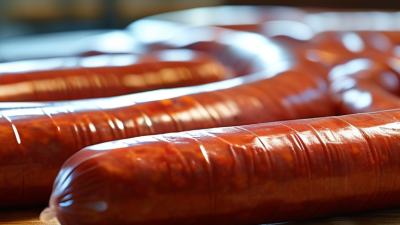
Top Pepper Lined Sausage Casings Suppliers for Global Buyers
Choosing reliable pepper lined sausage casings suppliers requires more than comparing prices or viewing attractive product images. Global buyers must examine casing structure, pepper distribution, stuffing performance, smoke absorption, and storage stability. A casing may look impressive in a sample photo, yet split during filling or wrinkle after cooking. Small details matter.
Dr. Jeffrey Sindelar, a respected meat science educator and sausage-processing specialist, offers a practical principle for this category: “Match the casing to the sausage, process, and customer expectation.” That idea guides this review of leading suppliers. Pepper lined sausage casings should support a consistent bite, clean appearance, and dependable production flow. Buyers should request technical sheets, sample rolls, traceability information, and clear storage instructions. Ask about pepper adhesion, diameter tolerance, moisture behavior, and compatibility with automated stuffing equipment. Do not rely on marketing language alone.
The strongest suppliers usually demonstrate process knowledge. They can explain how casing texture affects filling pressure and how pepper placement changes visual appeal. They should also communicate honestly about limitations. No casing performs perfectly in every recipe. Regional climate, transport time, and sausage formulation can expose weaknesses quickly. A refrigerated sample may behave differently after long international shipping. That point is easy to overlook.
This guide compares suppliers through a practical lens. It considers product consistency, documentation, customization, responsiveness, and buyer experience. Some evaluations may remain imperfect because supplier data changes. Still, careful verification can reduce costly surprises and support more confident purchasing decisions.

What Are Pepper-Lined Sausage Casings?
Pepper-lined sausage casings are edible or non-edible casings prepared with a pepper-containing layer. This layer usually sits on the inner surface, where it contacts the sausage mixture during stuffing and cooking. As heat and moisture develop, the pepper releases aroma and mild heat into the meat. It is not pepper sauce. The casing acts as a controlled flavor carrier.
The pepper may appear as fine black specks, coarse flakes, or a blended seasoning film. Its effect depends on pepper variety, particle size, coating weight, and cooking time. Natural casings can provide a tender bite, while manufactured casings often offer more consistent diameter and filling performance. The term is not perfectly standardized. Buyers should confirm whether “pepper-lined” describes an internal coating, an external coating, or seasoning already mixed into the casing material.
When evaluating global suppliers, request technical data before approving samples. Useful documents include food-contact declarations, ingredient lists, allergen statements, microbial results, and batch traceability records. Ask for casing diameter, length, storage temperature, stuffing pressure guidance, and recommended cooking conditions. During trials, inspect flavor distribution across the sausage, not only the first few pieces. Uneven pepper placement can create sharp pockets or weak sections. That detail matters. A practical test should also check breakage, shrinkage, smoke absorption, and final bite after chilled storage. Supplier communication may be excellent, yet production results can still differ between lots. Record those differences carefully.
Key Types, Materials, and Product Specifications
Global buyers should compare pepper-lined sausage casings by structure, not appearance. Natural casings, usually sheep or hog, provide irregular texture and traditional bite. Collagen casings offer tighter diameter control and cleaner production. Cellulose casings support high-speed processing but are generally removed before eating.
Material choice affects pepper performance. A supplier should state whether pepper sits inside, outside, or within a food-grade coating. Ask for caliber, wall thickness, length, moisture range, pepper particle size, and adhesion testing. For example, a 28–32 mm casing suits many fresh sausages, while larger calibers support thicker cured products. The detail matters. Pepper migration can create uneven flavor and weak spots during stuffing.
FAO food production data places global meat output above 350 million tonnes annually in recent years, sustaining demand for standardized casing systems. Recent market reports also identify collagen and artificial casings as major growth segments, although published forecasts differ considerably. That difference deserves caution. Buyers should request microbial certificates, allergen statements, food-contact compliance, and batch traceability. Codex food hygiene principles support documented hazard controls across processing and storage. A casing may look excellent but fail after cooking. I would test it under the buyer’s exact filling speed, humidity, cooking cycle, and pepper formula before approval. Supplier audits should include sample retention and burst-pressure records.
Top Pepper-Lined Sausage Casings Suppliers for Global Buyers
Key casing types, materials, and typical commercial caliber specifications
The chart compares commonly used nominal diameter ranges for pepper-lined sausage casings. Collagen and cellulose casings are generally selected for smaller snack and semi-dry products, natural hog casings are used for traditional linked sausages, and fibrous casings are commonly chosen for larger salami and pepperoni formats. Actual specifications may vary by product design, filling process, and buyer requirements.
How to Evaluate Pepper-Lined Casing Suppliers
Choosing pepper-lined sausage casings requires more than comparing price lists. A reliable supplier should explain casing material, pepper adhesion, diameter tolerance, and storage conditions. Ask for a production sample, not only photographs. Examine the inner surface under clear light. Pepper should appear evenly distributed, with no damp clumps or bare strips. Small variations can occur. Large variations may affect filling pressure and final appearance.
Request recent food-contact documentation, batch records, allergen controls, and a certificate of analysis for each shipment. Verify that the documents match the actual lot number. A credible supplier can describe cleaning, drying, seasoning, and packing controls in practical terms. They should also state shelf life, carton quantity, pallet dimensions, and temperature limits. These details matter when goods cross several climates. Test samples on your own stuffing line. Check breakage, stretch, smoke penetration, and pepper release after cooking. Laboratory data helps, but line performance is more revealing.
Communication is another quality signal. Suppliers should answer technical questions directly and report deviations before dispatch. Ask how they handle rejected lots, delayed vessels, and replacement claims. A written corrective-action process shows stronger accountability than promises. I would not select a supplier after one successful trial. Repeat testing is wiser, though it increases purchasing time. Some buyers overlook this weakness. Review three consecutive batches when possible, and keep retention samples for comparison. A supplier who welcomes inspection is usually easier to trust.
| Evaluation Dimension | What Global Buyers Should Evaluate | Practical Reference Benchmark | Documents or Evidence to Request | Suggested Weight |
|---|---|---|---|---|
| Product Definition | Confirm whether the product is a casing with an internal pepper layer, an external pepper coating, or a casing supplied with pepper seasoning. Clarify casing material, edible status, and intended sausage application. | The specification should clearly identify the casing type, pepper location, edible or inedible status, target sausage diameter, and processing conditions. | Technical data sheet, product drawing, product photographs, sample approval record, and written application instructions. | 12% |
| Food-Contact Compliance | Check compliance with the regulations applicable in the destination market and confirm that all casing and pepper-contact materials are suitable for food use. | For European sales, commonly requested evidence includes compliance with Regulation (EC) No. 1935/2004 and food-contact good manufacturing practice under Regulation (EC) No. 2023/2006. U.S. shipments require a market-specific food-contact compliance review. | Declaration of compliance, food-contact statement, material composition information, and destination-market regulatory assessment. | 15% |
| Food Safety System | Assess whether the manufacturing site operates a documented hazard-control system covering casing materials, pepper ingredients, sanitation, foreign bodies, and traceability. | A documented HACCP system is a basic requirement. Third-party certification such as ISO 22000, FSSC 22000, or BRCGS can provide additional assurance when the certificate scope covers the relevant site and product. | Current certificate, scope statement, latest audit summary, HACCP plan overview, and corrective-action records. | 15% |
| Microbiological Control | Review testing and release procedures for pathogens, indicator organisms, yeast, mold, and contamination risks associated with the casing and pepper component. | Limits must be defined according to the product category, processing method, and destination-market requirements. Testing should be performed using recognized laboratory methods. | Recent certificate of analysis, sampling plan, laboratory accreditation details, environmental-monitoring summary, and product-release procedure. | 13% |
| Pepper Quality and Consistency | Verify pepper species or blend, particle size, color, heat level, flavor profile, moisture control, and batch-to-batch uniformity. | The supplier should provide a defined pepper specification with acceptable ranges for appearance, flavor, heat intensity, moisture, and foreign material. | Pepper specification, ingredient statement, sensory approval standard, batch records, and representative production samples. | 12% |
| Allergen and Cross-Contact Management | Determine whether the pepper ingredient or production environment creates a cross-contact risk with regulated allergens or other restricted materials. | Pepper is not generally listed as a major allergen under U.S. or European allergen lists, but spice ingredients may still present cross-contact, contamination, or labeling risks. | Allergen-control plan, ingredient declarations, cleaning validation, supplier approval records for spices, and cross-contact statement. | 10% |
| Dimensional Performance | Evaluate diameter, length, wall strength, elasticity, stuffing speed, linking performance, and resistance to breakage or splitting. | Dimensional tolerances must be agreed in writing for each casing size. Performance should be validated on the buyer’s stuffing and cooking equipment rather than by appearance alone. | Dimensional inspection report, stuffing trial results, burst or tensile test data, and approved production sample. | 12% |
| Processing Compatibility | Confirm suitability for the buyer’s stuffing pressure, smoking, drying, cooking, chilling, freezing, and packaging processes. | The supplier should define maximum recommended processing conditions and identify any restrictions related to heat, humidity, smoke, or prolonged storage. | Processing guide, pilot-trial report, cooking-loss observations, and compatibility statement for the intended sausage recipe. | 8% |
| Shelf Life and Storage | Review the stated shelf life, storage temperature, humidity limits, packaging integrity, and handling requirements throughout international transport. | Shelf life must be supported by stability or historical quality data. Salted, dried, collagen, and other casing formats may have different storage requirements. | Shelf-life statement, storage specification, stability data, packaging specification, and transport-condition recommendation. | 8% |
| Traceability and Recall Readiness | Assess whether each batch can be traced from pepper and casing raw materials through production, packaging, shipment, and customer delivery. | A robust system should identify raw-material lots, production dates, finished-product lots, and distribution records, with a documented mock-recall process. | Lot-coding example, traceability procedure, mock-recall results, retention policy, and complaint-handling procedure. | 8% |
| Order Flexibility and MOQ | Compare minimum order quantities, standard pack sizes, private specification capability, sample policy, and repeat-order flexibility. | The acceptable MOQ depends on casing material, diameter, pepper formulation, and whether the item is standard or customized. Obtain a written quotation for both trial and commercial volumes. | Quotation, MOQ schedule, sample terms, customization policy, packaging options, and payment conditions. | 3% |
| Export and Delivery Reliability | Evaluate production capacity, lead time, export documentation, shipment protection, and communication during order changes or delays. | A qualified supplier should provide a documented lead-time range, Incoterms, export documents, batch identification, and a contingency plan for supply interruptions. | Capacity statement, delivery-performance history, sample shipping documents, Incoterms quotation, and business-continuity plan. | 2% |
Major Global Sourcing Regions and Supplier Profiles
Top Pepper Lined Sausage Casings Suppliers for Global Buyers
Major Global Sourcing Regions and Supplier Profiles
Europe remains a strong sourcing region for pepper lined sausage casings. Suppliers there often provide natural and collagen options with consistent diameters. Their profiles usually emphasize food-grade processing, batch traceability, and controlled pepper distribution. Many facilities also support custom casing lengths and smoke permeability. Buyers should inspect whether the pepper layer stays stable during filling, cooking, and storage.
East Asia offers competitive production capacity and flexible private specifications. Several suppliers focus on collagen casings with uniform thickness and efficient export packaging. North American producers often highlight quality systems, technical support, and stable cold-chain coordination. South American suppliers may provide regional expertise in natural casings and spice integration. However, performance can vary between batches. That detail is easy to overlook.
Tips: Request samples from at least three regions. Test stuffing pressure, cooking loss, bite, and pepper adhesion. Review allergen controls, microbiological testing, origin records, and export documents. Ask for recent audit evidence, not only certificates. A clear product sheet should state casing diameter, moisture range, pepper type, and storage conditions.
Price alone can mislead. A lower quote may involve higher breakage or inconsistent visual coverage. During supplier evaluation, record test temperatures and filling speeds. Keep photographs of each sample. One weakness in many comparisons is limited long-term storage testing. Add it when possible. Reliable suppliers accept technical questions and explain limitations without vague promises.
Quality Standards, Pricing Factors, and Import Requirements
For global buyers, pepper-lined sausage casings should meet clear food-contact and performance standards. Suppliers should provide material specifications, pepper-allergen declarations, microbial results, and batch traceability. Check casing diameter, wall strength, moisture tolerance, and filling performance using production samples. Details matter. A reliable supplier can explain how pepper is cleaned, processed, and evenly distributed inside the casing. Independent laboratory reports add credibility, but buyers should verify report dates and batch numbers.
Pricing depends on casing material, pepper quality, diameter, length, customization, and order volume. Packaging and export handling can also change the final cost. A low quotation may exclude testing, special packing, or inland delivery. That mistake is common. Request a full landed-cost breakdown, including samples, documentation, freight, insurance, and possible inspection fees. Payment terms and minimum order quantities deserve equal attention. Cheaper is not always safer.
Import requirements vary by destination and product classification. Buyers should confirm the correct HS code with customs brokers and local authorities. Typical documents include a commercial invoice, packing list, certificate of origin, product specification, and applicable health or conformity certificates. Some markets require facility registration, prior import approval, or specific allergen labeling. Confirm whether the casings require temperature control during transport. Dry packaging may still suffer from heat and humidity. Keep written approval records, because verbal guidance can be misunderstood.
Related Posts
-
Top Benefits of Using Plastic Sausage Casing for Factories?
-

How to Choose the Best Fibrous Casing Suppliers for Your Needs?
-
How to Choose the Right Food Casings for Your Culinary Needs?
-

Best Pepper Lined Sausage Casings at 2026 Canton Fair?
-
How to Choose Clear Fibrous Casings for Best Sausage Making?
-
What is Clear Fibrous Casings and How Are They Used?