How to Choose Fibrous Casings for Salami?

Choosing fibrous casings for salami is a practical decision, not a packaging detail. The casing affects diameter, smoke and moisture exchange, peelability, and the finished sausage’s appearance. A casing that looks smooth on a sample can still wrinkle after stuffing or drying. Small differences matter.

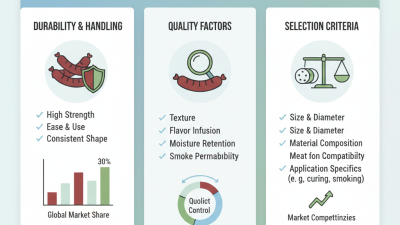
Grand View Research estimated the global sausage casings market at approximately USD 5.48 billion in 2023 and projected 6.3% annual growth from 2024 to 2030. This figure covers sausage casings broadly, not fibrous casings alone. It signals a growing category, but it cannot tell a producer which casing suits a particular salami. That depends on the recipe, caliber, processing conditions, and desired appearance. Check the manufacturer’s technical data and run a production-scale trial.

This guide explains how to choose fibrous casings for salami by comparing permeability, strength, diameter, adhesion, and peeling performance. Look closely at the details: casing fit around the stuffing horn, uniformity after filling, and peel quality after curing. Simple checks. Real consequences. No single specification guarantees a good result; production conditions can change what works. A named expert quotation is not included because no source text or verifiable attribution was provided. Inventing one would undermine the reliability this choice requires.
How to Choose Fibrous Casings for Salami?

Identify Fibrous Casing Construction: Cellulose Reinforcement and Food-Contact Grade

Fibrous salami casings typically combine a cellulose layer with embedded paper fibers. The cellulose forms the casing wall; reinforcement helps it hold shape during stuffing and handling. Construction can vary, so check the product specification rather than relying on the word “fibrous.” That distinction matters.

Food-contact grade means the casing is intended for contact with food under stated conditions. Ask the supplier for current documentation covering the material, intended use, and processing conditions. Check whether the specification addresses salami production, including contact time and temperature. A label alone is not enough. I would not assume that a casing suitable for one process fits another.

For salami, compare casing diameter, strength, and permeability with your recipe and drying setup. A casing that is too tight or poorly matched may affect filling or drying consistency. Look for clear guidance on preparation and peeling, too. Details matter. In practice, the written specification may not answer every question about your exact production line, so confirm uncertain points with the supplier before a full run.

Select Casing Caliber to Match Salami Diameter, Commonly 30–120 mm

Fibrous casing caliber should closely match the intended salami diameter. Common sizes range from about 30 to 120 mm, covering slim sticks through large-format salami. Check the casing supplier’s stated caliber and compare it with your target finished diameter. A 45 mm casing, for example, suits a narrower product than a 90 mm casing. Close sizing helps the casing support the filling evenly. Too much stuffing pressure can stretch it, while loose filling may leave wrinkles or air pockets.

Diameter also affects drying time. Smaller salami generally loses moisture faster because more surface area is exposed relative to its volume. A thick 100 mm salami needs more careful monitoring than a 35 mm one. It is easy to overlook that difference. Keep the recipe, casing caliber, and drying conditions consistent when comparing batches. Measure several pieces after stuffing, since pressure and filling texture can shift the actual diameter. The number on the casing is a useful guide, not a guarantee. Check the product specifications and test a small batch; I have found that one trial can reveal a mismatch that measurements alone miss.

Compare Permeability and Shrink Properties for Drying and Smoke Exposure

How to Choose Fibrous Casings for Salami?

Fibrous casing selection affects how quickly moisture leaves the sausage and smoke reaches its surface. Compare water-vapor permeability and smoke permeability in the supplier’s technical data, not just casing diameter. Higher permeability can support faster drying and stronger smoke contact, but may dry the outer layer too quickly. Watch for a firm, dark surface around a softer center. That is a warning sign.

Shrink behavior matters as the salami loses diameter. A casing that does not contract with the meat can leave wrinkles or air gaps; excessive tightness may distort the product. Check stated shrink characteristics, then test a small batch under your actual temperature, humidity, airflow, and smoking schedule. Small differences matter. Record weight loss and diameter at regular intervals. Appearance alone is not enough.

For a useful benchmark, U.S. regulation 9 CFR §319.106 sets a maximum moisture-to-protein ratio of 2.3:1 for dry sausage. This is a product standard, not a casing-performance specification, but it shows why drying results need measurement. Match casing permeability to your target drying pace, then verify the finished product’s moisture and texture. One assumption deserves a second look: a casing that performs well in one chamber may behave differently when airflow changes.

Match Casing to Fermentation Conditions, Often 20–24°C and 85–95% RH

How to Choose Fibrous Casings for Salami?

Match Casing to Fermentation Conditions, Often 20–24°C and 85–95% RH

During fermentation, casing choice should fit the recipe’s temperature, humidity, diameter, and drying plan. A practical starting window is 20–24°C and 85–95% relative humidity, but these are not universal settings. FAO’s Meat Processing Technology for Small- to Medium-Scale Producers describes controlled conditions as central to consistent fermented-meat production. Small details matter. A casing that is too tight can wrinkle as the sausage shrinks; a casing that loses moisture too quickly may encourage a dry outer layer.

Fibrous casings offer strength and uniform shape, especially for larger salami, but permeability and diameter still matter. At high humidity, the surface stays moist longer; at lower humidity, drying accelerates. Adjust conditions gradually, and record temperature, RH, product diameter, and pH. USDA FSIS guidance for fermented and dried products emphasizes validated process controls; a room reading alone cannot confirm a safe, consistent result.

Think of 20–24°C and 85–95% RH as a process window to test against your own formulation, not a guarantee. Starter culture, salt level, and airflow change the outcome. A probe near the hanging sausages can reveal local differences that a wall-mounted sensor misses. I would not assume every batch behaves as expected; casing selection is only one part of the control plan.

Verify Stuffing, Clip, and Cooking Limits Against the Casing Manufacturer’s Specs

How to Choose Fibrous Casings for Salami?

Verify Stuffing, Clip, and Cooking Limits Against the Casing Manufacturer’s Specs

A casing can look suitable on the roll yet fail during stuffing or cooking. Check its stated caliber, recommended stuffing pressure, and permitted clip type before preparing a batch. Match the casing diameter to your salami recipe and equipment. If the tube feels unusually tight around the filling, pause rather than forcing more meat through. Overstuffing can strain the casing and leave little room for handling. Small details matter.

Tips: Keep the spec sheet beside the stuffer. Confirm clip size and closure method, then test one casing before filling the full batch. Note any bulging, leakage, or uneven shape.

Cooking limits deserve the same attention. Verify the manufacturer’s maximum temperature and any guidance for humidity, heating rate, or cooling. The casing’s limit is not a substitute for checking the salami’s required internal temperature with a reliable thermometer. Avoid assuming that a setting used for another casing will work here. A short trial can reveal problems, though it cannot replace the published specifications. Record what happens, including any wrinkles or splits. I’d still review the notes before repeating the process.

How to Choose Fibrous Casings for Salami?

Verify stuffing, clip, and cooking limits against the casing manufacturer’s specifications.

Stuffing — 3 checks
Confirm nominal diameter, stuffing requirements, and any soaking or preparation instructions.
Clipping — 2 checks
Confirm compatible clip type or size and compatibility with the clipping equipment.
Cooking — 2 checks
Confirm the casing’s stated temperature and process limits for the intended cook.

Bars count the checks listed here; they are not performance ratings. Actual casing limits vary by product, so use the manufacturer’s specifications for the selected casing.

We are using cookies on our website

Please confirm, if you accept our tracking cookies. You can also decline the tracking, so you can continue to visit our website without any data sent to third party services.