China Best Fibrous Casings for Salami Where to Buy?
China has become a central sourcing market for salami manufacturers, supported by strong meat processing capacity and expanding food manufacturing investment. The OECD-FAO Agricultural Outlook 2024–2033 identifies China as one of the world’s largest meat consumption and production markets. This scale creates more supplier choices, but it also makes product comparison harder. The best fibrous casings for salami must support stable filling, controlled drying, reliable smoke penetration, and clean peeling.
Performance begins with technical fit. Buyers should check casing diameter, tensile strength, moisture transfer, shrinkage, and stuffing tolerance. A casing that looks attractive in a sample may split on a high-speed line. Small details matter. Ask suppliers for food-contact declarations, batch traceability, microbiological controls, and testing records. The FAO and Codex Alimentarius food safety principles support this evidence-based approach. China-based manufacturers should also explain their quality systems, export experience, and production consistency.
Where to buy depends on the project. Direct factory purchasing may offer better customization and technical support. Verified industrial platforms can provide wider comparisons, but listings alone cannot prove performance. Request samples and run a controlled trial with your own meat formulation. Measure filling pressure, drying loss, surface appearance, and peeling after maturation. The global meat casing sector continues to develop alongside processed meat demand, as noted by market studies from MarketsandMarkets and Grand View Research. However, market forecasts are not purchasing guarantees. No supplier list is perfect. A lower price may hide inconsistent sizing, weak service, or delayed documentation. Careful testing remains the most reliable path to choosing China’s best fibrous casings for salami.
Fibrous Casings Explained: Cellulose, Fiber, and 50–70 mm Salami Calibers
China Best Fibrous Casings for Salami Where to Buy?
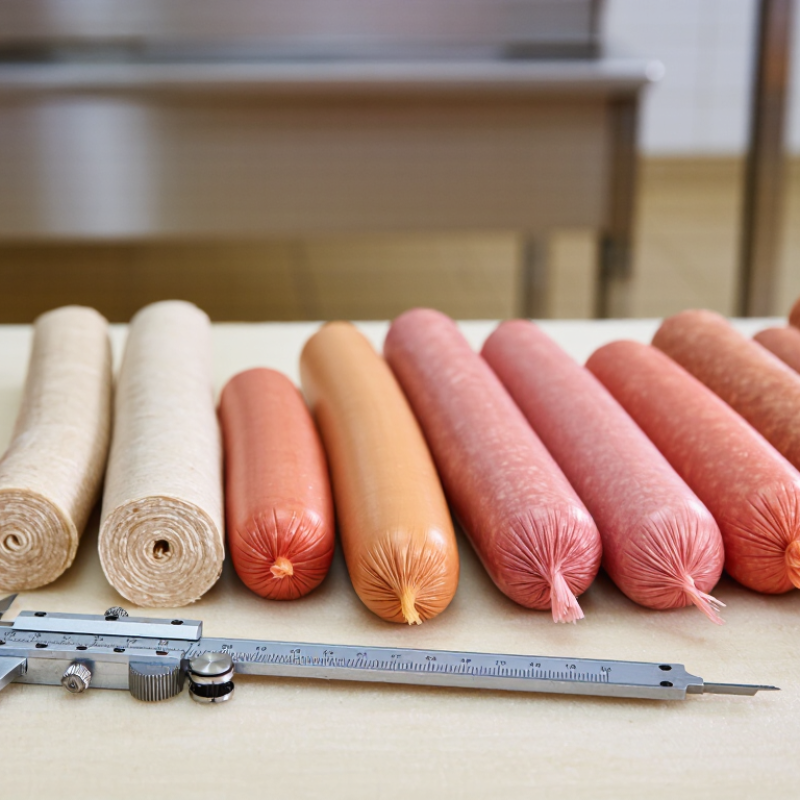
Fibrous casings combine regenerated cellulose with a strong paper-like fiber layer. The cellulose controls shape, while the fiber reinforcement prevents splitting during stuffing and hanging. They are usually non-edible and peeled after processing. Their porous structure allows smoke and moisture movement, which supports a firm, colored salami surface.
For 50–70 mm salami calibers, diameter affects drying time, texture, and weight loss. A 50 mm casing may dry more evenly than a 70 mm casing. The larger size can retain a softer center for longer. Fill the casing evenly, but do not stretch it aggressively. Overstuffing may create wrinkles or burst points. This detail is easy to miss.
When buying from a Chinese manufacturer, request samples in several diameters. Check casing strength, stuffing performance, shrinkage, printing accuracy, and peeling after cooking. Ask for food-contact documentation, batch records, and storage instructions. A reliable supplier should explain cellulose composition, fiber reinforcement, moisture tolerance, and recommended clipping methods. I would also test the casing with your own recipe, because one casing can behave differently with high-fat mixtures or heavy garlic seasoning. Supplier photos are useful, but they cannot replace a production trial.
China Best Fibrous Casings for Salami Where to Buy?
Fibrous Casings Explained: Cellulose, Fiber, and 50–70 mm Salami Calibers
Fibrous casings are paper-based casings reinforced with cellulose fibers. They are commonly used for formed and dry sausages because they provide dimensional support during filling and processing. The chart compares nominal salami casing diameters from 50 to 70 mm with their calculated circumference.
China Supplier Standards: GMP, HACCP, and ISO 22000 Certification
When buying fibrous casings for salami from China, certification should guide your supplier search. GMP shows whether the factory controls hygiene, personnel practices, equipment cleaning, and production procedures. Look for clean changing rooms, covered materials, and recorded sanitation checks. The details matter.
HACCP should identify risks across soaking, printing, drying, packing, and storage. Ask to review the hazard plan, monitoring records, and corrective actions, with sensitive information removed. A reliable supplier can explain how each casing lot is traced from raw material to shipment. Lot codes should match cartons, production dates, and inspection records.
ISO 22000 adds a structured food safety management system, but the certificate requires careful checking. Confirm the issuing body, certificate validity, factory address, and certified scope. The scope should clearly include fibrous food casings, not only an unrelated activity. Ask for recent audit results or a controlled document list. Also request product specifications, migration or food-contact test reports, and samples from a normal production batch.
Do not rely on a certificate image alone. It can be outdated. A video call may reveal storage conditions, but an independent audit gives stronger evidence. One practical check is measuring casing diameter, length, moisture, and stuffing performance during a trial. Minor wrinkles may be acceptable, yet uneven seams or poor peelability deserve investigation. Supplier selection becomes safer when documents, factory conditions, and sample performance agree.
| Evaluation Dimension | Recommended Requirement | Why It Matters for Salami | Evidence to Request from a Supplier | Buyer Verification Point |
|---|---|---|---|---|
| Product and Casing Performance | ||||
| Basic casing construction | Food-contact fibrous casing made from cellulose-based material reinforced with suitable fibers. | Provides strength and dimensional stability during stuffing, linking, drying, storage, and transport. | Technical data sheet, material declaration, food-contact compliance statement, and product specification. | Confirm that the casing is intended for fermented or dry-cured sausage applications. |
| Smoke permeability | Specify smoke-permeable construction when the salami process includes natural or liquid smoke exposure. | Controls the transfer of smoke components and supports the expected color and flavor development. | Application guide, permeability information, and process recommendations. | Run a production trial because smoke uptake depends on casing type, humidity, temperature, and smoking conditions. |
| Peelability | Choose peelable or non-peelable casing according to the finished-product presentation. | Peelable casings support slicing and retail presentation; non-peelable options may remain on the product during storage or sale. | Product description, peeling instructions, and sample evaluation report. | Test peeling after the actual fermentation, drying, and storage process. |
| Size and tolerance | Order the diameter, flat width, length, and tolerance specified for the sausage filling line. | Correct sizing helps maintain uniform weight, appearance, drying rate, and filling efficiency. | Dimensional specification, calibration records, and inspection procedure. | Match the casing dimensions with the horn, clipper, linker, and target finished diameter. |
| Mechanical strength | Require strength suitable for stuffing pressure, linking, hanging, and handling. | Reduces bursting, splitting, leakage, and product loss during processing. | Internal quality standard, test method, batch inspection record, and sample rolls or sticks. | Check burst resistance and handling performance under the intended filling pressure. |
| Moisture and drying behavior | Confirm compatibility with the planned fermentation and drying profile. | The casing affects moisture migration, surface drying, mold management, and final texture. | Recommended temperature, relative humidity, airflow, and storage conditions. | Validate water-loss behavior with a pilot batch before approving regular supply. |
| Food-contact safety | Materials must be suitable for the intended food-contact application and comply with the destination market’s legal requirements. | Supports regulatory compliance and reduces the risk of chemical or physical contamination. | Declaration of compliance, migration test reports where applicable, allergen statement, and ink or adhesive information. | Check documents against the importing country’s food-contact regulations and product use conditions. |
| Supplier Food-Safety Standards | ||||
| GMP: Good Manufacturing Practice | Documented controls for hygiene, personnel practices, premises, equipment, sanitation, pest control, storage, and process operations. | GMP provides the basic hygienic conditions needed to manufacture safe food-contact packaging. | GMP manual, sanitation records, pest-control records, training records, and internal inspection reports. | Confirm that the documented program covers the actual manufacturing site and product category. |
| HACCP system | A hazard-based food-safety plan covering hazard analysis, critical control points where applicable, critical limits, monitoring, corrective action, verification, and records. | Identifies and controls biological, chemical, and physical hazards associated with manufacturing and handling. | HACCP plan, hazard analysis, flow diagram, monitoring forms, corrective-action records, and verification results. | Check that the plan is product- and process-specific rather than a generic template. |
| ISO 22000 certification | Valid certification to ISO 22000 for the relevant manufacturing site and scope. | ISO 22000 specifies requirements for a food-safety management system, including communication, prerequisite programs, hazard control, management review, and continual improvement. | Current certificate, certification scope, certificate number, issuing certification body, and expiry date. | Verify the certificate directly through the certification body or an official certification database where available. |
| Certification scope | The certificate scope should cover the production of the supplied fibrous casing or the applicable food-contact packaging activity. | A certificate may not cover every product, process, building, or location operated by a supplier. | Certificate scope, site address, included processes, and any exclusions. | Ensure the quoted factory address is the same site named on the certificate. |
| Audit and certificate status | Certificate should be current, issued by a competent certification body, and supported by completed surveillance or recertification activities as applicable. | Confirms that the management system is subject to ongoing external assessment. | Certificate validity dates, audit status, and certification-body contact details. | Do not rely solely on a logo or scanned document; independently verify status before purchase. |
| Traceability and recall readiness | Lot-level identification from raw materials through production, inspection, packing, and shipment. | Enables rapid investigation and targeted action if a quality or safety issue occurs. | Traceability procedure, sample batch record, coding format, mock-recall results, and retention policy. | Request a sample lot code and confirm that the supplier can trace it to production and raw materials. |
| Testing and release control | Documented release checks for dimensions, appearance, strength, packaging integrity, and other agreed specifications. | Helps maintain consistent casing performance across repeated shipments. | Certificate of analysis or conformity, inspection plan, test results, and nonconformance records. | Agree in writing on acceptance criteria, sampling level, and handling of nonconforming goods. |
| Where and How to Buy | ||||
| Suitable sourcing channels | Direct factory inquiry Verified B2B marketplace Food-packaging distributor Industry trade fair | Different channels provide different levels of technical support, sample access, documentation, and order flexibility. | Supplier profile, factory address, product catalog, certification documents, export experience, and references where available. | Use the same qualification checklist regardless of the purchasing channel. |
| Sample and trial order | Obtain representative samples before placing a production-volume order. | Laboratory documents cannot replace a trial under the buyer’s actual stuffing, fermentation, smoking, drying, and storage conditions. | Sample specification, batch identification, trial quantity, and technical support contact. | Record filling speed, breakage, peeling, smoke response, drying performance, and finished appearance. |
| Packaging and storage | Packaging should protect the casing from moisture, contamination, deformation, and physical damage during transport and storage. | Improper storage can affect casing strength, dimensions, and usability even when the original product is compliant. | Packaging specification, storage temperature and humidity guidance, shelf-life statement, and transport instructions. | Inspect outer cartons, inner packaging, lot codes, and moisture damage immediately upon receipt. |
| Commercial terms | Confirm minimum order quantity, lead time, payment terms, Incoterms, customization options, and replacement policy. | Clear terms reduce supply interruptions and disputes over specification or delivery performance. | Formal quotation, pro forma invoice, approved specification, delivery schedule, and quality agreement. | Make the approved casing specification and acceptance criteria part of the purchase contract. |

How to Match Diameter, Smoke Permeability, and 70–80% Aging Humidity
Choosing the best fibrous casing for salami starts with diameter, smoke permeability, and humidity control. A casing that is too wide can dry slowly at the center. A narrow casing may lose moisture too quickly. For many fermented salamis, 45–65 mm casings provide a practical balance, but the recipe and drying chamber matter more than a fixed number. The American Meat Science Association notes that product diameter strongly affects drying time and moisture migration.
Smoke permeability depends on fiber structure, coating, and casing moisture. Uncoated fibrous casings usually allow more smoke contact than heavily coated versions. However, greater permeability can create a dry outer ring. The FAO Good Practices for the Meat Industry emphasizes controlled temperature, airflow, and humidity during meat drying. Keep the chamber near 70–80% relative humidity during the main aging stage. Lower humidity may harden the surface too soon. Higher humidity can encourage unwanted surface growth. It is not perfectly simple.
Tips: Ask suppliers for diameter tolerance, smoke-permeability data, recommended stuffing pressure, and storage conditions. Buy through audited casing manufacturers or professional meat-processing distributors. Request food-contact documentation and batch traceability. Match the casing diameter to the sausage weight, not only the recipe name. Measure water activity regularly; industry safety guidance commonly uses 0.90 or lower for many shelf-stable fermented products, but product validation remains necessary. I would test one small batch first. Experiences differ between chambers, and my own preferred humidity setting may not suit every salami formula.
Where to Buy: OEM Minimum Orders, Export Documents, and Factory Audits
China Best Fibrous Casings for Salami Where to Buy?
When sourcing fibrous casings for salami in China, assess the factory before comparing prices. In my purchasing work, stable diameter and clean peeling mattered more than attractive samples. Ask for casing caliber, meat adhesion, smoke permeability, moisture tolerance, and printed or unprinted options. Request production samples from different batches. One sample proves very little. A reliable supplier should explain its process, not only send a catalogue.
OEM minimum orders need written confirmation. Ask whether the MOQ applies per size, color, print design, or total shipment. Small trial orders may cost more per unit, but they reduce expensive mistakes. Confirm lead time, packaging, shelf life, and replacement terms.
For export, request commercial invoices, packing lists, certificates of origin when required, and relevant food-contact compliance documents. Import rules vary by destination. A customs specialist should verify the final document set. I have seen delays caused by one missing carton detail.
Tips: Audit the factory by video or in person. Check extrusion areas, drying rooms, storage temperature, pest controls, and batch records. Match the audit date with recent production evidence. Ask for traceability from raw material to shipment. Keep signed specifications and approval samples. Do not rely on polished photos. An audit can still miss problems, so schedule a pre-shipment inspection. That extra step is not perfect, but it can expose weak packaging and inconsistent sizing before departure.
Quality and Cost Checks: Yield, Tensile Strength, and Defect Rates
China Best Fibrous Casings for Salami Where to Buy?
Buying fibrous casings in China requires more than comparing carton prices. A reliable supplier should provide food-contact documentation, batch traceability, and clear production specifications. Ask for samples before ordering. Check diameter accuracy, moisture balance, peeling performance, and smoke permeability. During filling, a casing should remain stable around the meat without loose folds. Small variations can affect slicing and appearance.
Cost should be measured through yield, not price alone. Record how many salamis each carton produces, including damaged pieces and trimming losses. Tensile strength matters during stuffing, linking, drying, and transport. Request test data, but verify it with your own filling trial. Count splits, pinholes, uneven printing, and poor peeling. My first comparison focused too heavily on unit cost. That mistake hid higher defect rates. A cheaper carton may create more waste.
Tips: Use a controlled trial with the same meat, stuffing pressure, and drying conditions. Test at least three production batches. Compare usable output, not promises. Keep photos of defects and written inspection records. If results vary widely, pause the purchase and ask for corrective action. No supplier is perfect, and your own process may also need review.
Related Posts
-
What is Clear Fibrous Casings and How Are They Used in Food Industry
-
2026 How to Choose Mahogany Fibrous Casings?
-
What Are Cellulose Casings for Hot Dogs?
-
What is Casing Food and How is it Used in Culinary Practices?
-
Top Benefits of Using Plastic Sausage Casing for Factories?
-
Top Pepper Lined Sausage Casings Suppliers for Global Buyers