China Top 10 Butchers Elastic Netting Suppliers?
Choosing a reliable supplier for butchers elastic netting takes more than comparing prices. The right mesh can help meat products hold their shape during handling and cooking. Yet a sample that looks suitable may behave differently on a production line. Small details matter.
This guide introduces ten Chinese suppliers for buyers to research, not as a certified ranking. It highlights practical comparison points: product sizes, mesh options, material information, customization, sample availability, and communication. Ask for clear specifications and confirm that samples match the requirements of your process. If your products need consistent coverage, test net tension and fit on representative cuts before placing a large order. Details matter.
Supplier claims deserve careful review. Request current product documents, production information, and references where available. Check how the company handles repeat orders, packaging, lead times, and quality concerns. A quick reply is useful, but it cannot replace evidence. Some supplier information may be incomplete or change over time; verify key details directly and record them. This takes work. The comparison should help readers narrow their options while leaving room for independent checks. No list can guarantee a perfect match. A thoughtful trial order can reveal issues that a polished catalogue may not show.
What Butcher’s Elastic Netting Is and How It Is Used
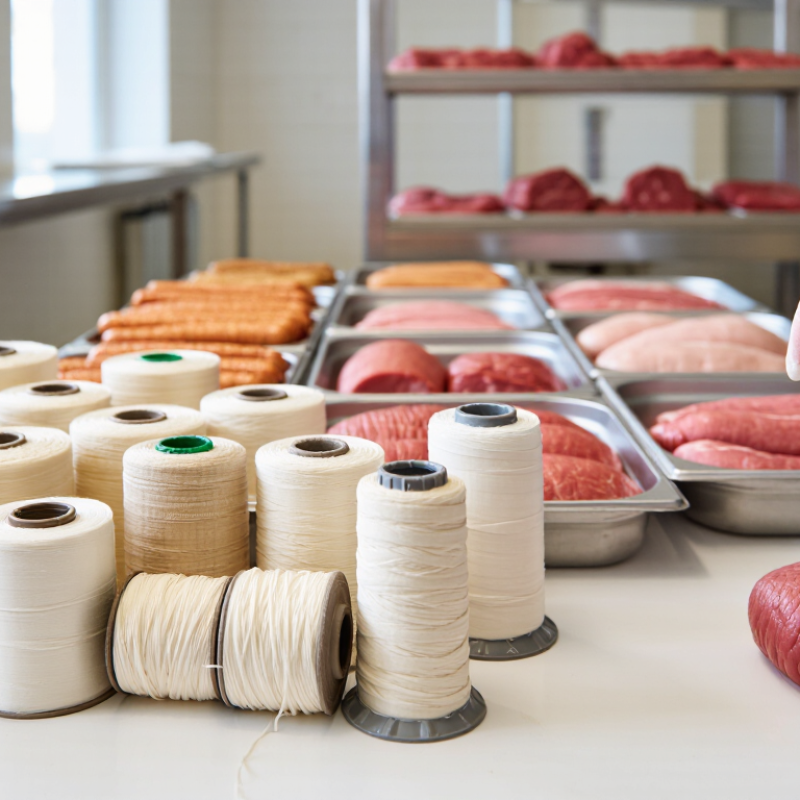
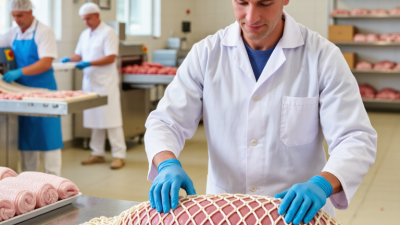
Butcher’s elastic netting is a stretchable mesh applied around meat before cooking, smoking, chilling, or display. It helps hold a roast’s shape and keeps muscle groups or fillings together during handling. The open weave allows smoke and heat to reach the surface. After cooking, the net can leave a familiar crisscross pattern. Useful, but not magic.
In practice, a butcher selects netting for the product’s diameter, weight, and process temperature. A tight fit can help produce an even shape, while excessive tension may mark the meat or make removal difficult. Operators commonly load the net onto a tube, slide the prepared cut through, then tie or clip the ends. Clean equipment matters. So does checking that the mesh stays intact through the process.
Industry context helps explain the demand for dependable packaging materials. Grand View Research estimated the global meat packaging market at USD 13.56 billion in 2023, reflecting the scale of meat processing and distribution. That figure covers meat packaging broadly, not elastic netting alone. For buyers comparing suppliers in China, ask for material specifications, temperature limits, food-contact documentation, and sample rolls for production trials. A neat sample is not proof of consistent performance. Test it on the actual cut.
How China’s Elastic Netting Supply Market Is Organized
China’s elastic netting supply market is organized around specialized converters, materials suppliers, and export-focused trading companies. Some manufacturers extrude or source food-contact polymer yarn, then knit it into tubular netting and cut it to specified lengths. Others focus on converting, inspection, and packing. This division matters. A supplier may control knitting but outsource yarn production, so buyers should ask where each production step occurs.
The China National Textile and Apparel Council reported that China’s industrial textile sector recorded about 1.18 trillion yuan in operating revenue in 2023. That figure describes the wider sector, not butcher netting alone; public industry reports rarely isolate this product category. Still, it shows the depth of the upstream manufacturing base. In practice, buyers can compare suppliers by mesh size, stretch recovery, roll or cut-piece format, batch traceability, and documented food-contact suitability. Ask for samples from the intended production line. A neat sample is not enough. Production consistency can vary, and I would not assume every trading company has direct control over its factory. Exporters may coordinate orders and documentation, while specialized plants handle knitting and finishing. These layers can improve access, but they can also make responsibility less clear.
China Top 10 Butchers Elastic Netting Suppliers? – How China’s Elastic Netting Supply Market Is Organized
China’s elastic netting supply market is best understood by supplier role rather than by an unverified company ranking. The following market map describes ten common supplier profiles and their typical capabilities; it does not identify or rank individual businesses.
| Market position | Supplier profile | Typical product focus | Common customer need | Sourcing considerations |
|---|---|---|---|---|
| 1 | Specialist meat-netting manufacturer | Elastic tubular netting for forming and holding boneless meat products during processing | Consistent fit, reliable processing performance, and repeat production supply | Confirm permitted food-contact use, material specifications, mesh dimensions, and application suitability. |
| 2 | Knitted-netting producer | Knitted elastic constructions in different mesh patterns and tube sizes | Product flexibility and a choice of construction for different product shapes | Request samples and check stretch, recovery, opening size, and dimensional tolerances. |
| 3 | Woven-netting producer | Woven or mesh-style netting products, depending on the producer’s equipment and specifications | A defined structure or appearance for a particular production process | Verify that the construction is suitable for the intended use; woven and knitted products are not interchangeable by default. |
| 4 | Custom-size converter | Cut-to-length, tubular, or otherwise converted netting supplied to customer dimensions | Specified lengths, widths, packaging formats, or private-label packing | Agree on measurement methods, tolerances, roll or piece format, and packaging details before ordering. |
| 5 | Food-processing consumables supplier | Netting supplied alongside other meat-processing consumables | Consolidated purchasing and a broader consumables assortment | Determine whether the supplier manufactures the netting or sources it from another producer. |
| 6 | OEM and contract-production supplier | Customer-specified netting made or packed to an agreed specification | Production under buyer-defined dimensions, packaging, or documentation requirements | Document specifications, sample approval, change control, and responsibility for compliance records. |
| 7 | Export-oriented manufacturer | Netting prepared for overseas orders and export shipment | Cross-border supply, export documentation, and coordinated shipping | Confirm export experience, trade terms, lead time, shipping configuration, and required destination-market documents. |
| 8 | Trading and sourcing company | Products sourced from one or more manufacturing partners | Supplier coordination, order consolidation, or access to a wider product range | Ask for the manufacturing origin, traceability information, and the party responsible for quality control. |
| 9 | Packaging-material distributor | Netting offered as part of a packaging and processing-material catalogue | Convenient replenishment with other packaging supplies | Check stock availability, product specification consistency, and whether samples match the supplied batch. |
| 10 | Regional industrial supplier | Locally stocked netting or products sourced for nearby food-processing customers | Smaller orders, local communication, or shorter domestic delivery routes | Clarify whether products are locally stocked or made to order, and confirm minimum order quantities and delivery timing. |
Buyer checklist: Before purchasing, specify intended application, material composition, tube dimensions, mesh construction, stretch and recovery requirements, packaging format, order quantity, and destination-market compliance needs. Food-contact suitability and regulatory documentation should be verified for the exact product and intended use.
Profiles of 10 Butcher’s Elastic Netting Suppliers in China
China’s butcher’s elastic netting suppliers vary in materials, production scale, and customization. One focuses on cotton-blend netting for traditional roasts. Another offers food-contact-tested synthetic mesh in several diameters. A third specializes in narrow rolls for small processing rooms. Some suppliers provide wider netting for large cuts. Others make tighter meshes to help hold uneven shapes. Ask about stretch recovery. It matters.
A fourth supplier may support custom colors and roll lengths, while a fifth emphasizes consistent mesh spacing. A sixth could offer netting suited to manual stuffing. A seventh may cater to automated filling lines, where steady tension is important. An eighth might serve regional wholesalers with standard sizes. A ninth may handle smaller trial orders, though lead times can vary. A tenth could combine netting production with basic packaging options. These are useful profile types, not verified company claims. Request current specifications, sample rolls, and test records before comparing quotes. Check whether the mesh stays secure after cooking and handling. Small details can change the result. Supplier descriptions alone are not enough.
How to Compare Suppliers by Materials, Sizes, and Customization
When comparing China’s butcher elastic netting suppliers, look beyond the quoted price. Ask what the netting is made from, and request a specification sheet for each option. Food-contact suitability should be documented for the intended use. The material also needs to tolerate your processing conditions, including cooking temperature if the netting will be heated. A sample tells you more than a product photo. Stretch a piece around a roast-shaped form, then check whether the mesh keeps its shape without cutting into the surface. Small details matter.
Sizes can vary by relaxed width, stretched width, mesh opening, and roll length. Make sure both sides are discussing the same measurement. A net that fits a narrow tenderloin may not hold a wide ham securely. Ask suppliers for size ranges and sample pieces before placing a large order. For customization, clarify whether they can adjust elasticity, mesh pattern, color, or packaging, and ask about minimum order quantities and lead times. Request a written sample approval process, too. It may feel fussy. But a clear record can prevent a costly mismatch between the test roll and the production batch. Supplier responses are useful evidence: precise answers and consistent specifications inspire more confidence than broad promises.
How to Compare Butcher’s Elastic Netting Suppliers
Suggested evaluation weights for comparing suppliers by materials, sizes, and customization—not supplier-specific ratings or market statistics.
Use the same product requirements when requesting quotes. Verify material composition, usable size range, customization options, and food-contact documentation directly with each supplier.
What Buyers Should Check Before Placing an Order
China Top 10 Butchers Elastic Netting Suppliers? What Buyers Should Check Before Placing an Order
A low price means little if the netting stretches unevenly or slips during cooking. Ask suppliers for mesh dimensions, strand composition, elongation, recovery, and breaking-load results. Request test reports tied to the exact product and production lot, not a generic sample. Then test a roll on the meat shape and filling weight you actually use. Check that knots stay firm and the net does not leave deep marks after cooking. Small differences matter.
Food-Contact Compliance
Food-contact paperwork deserves close attention. Confirm the material’s intended temperature range and suitability for direct contact with food, including during heating if applicable. The FDA Food Code 2022 sets cold-holding guidance at 41°F (5°C) or below for time/temperature control foods; this does not certify netting, but it highlights why storage and handling conditions should be clear. Ask for a declaration of compliance and supporting migration or material test reports for the destination market. Keep the documents with the purchase record.
Before Placing a Volume Order
Before ordering volume, request a pre-production sample and a written specification covering roll length, mesh opening, color, packaging, and acceptable variation. Check lot coding, traceability, lead time, and the supplier’s process for handling defects. Confirm whether the quoted price includes testing and export packaging. One awkward point: samples can perform well while bulk rolls vary. Set measurable acceptance limits, inspect incoming lots, and retain a sealed sample for comparison.
Related Posts
-
China Top Butchers Netting Suppliers for Global Buyers?
-
5 Best Nets for Smoking Meat How Do You Choose?
-
7 Tips for Buying Butchers Elastic Netting
-
How to Choose Meat Netting UK Suppliers in 2026?
-
How to Choose the Best Elastic Meat Netting for Your Needs?
-
How to Choose the Right Food Casings for Your Culinary Needs?